


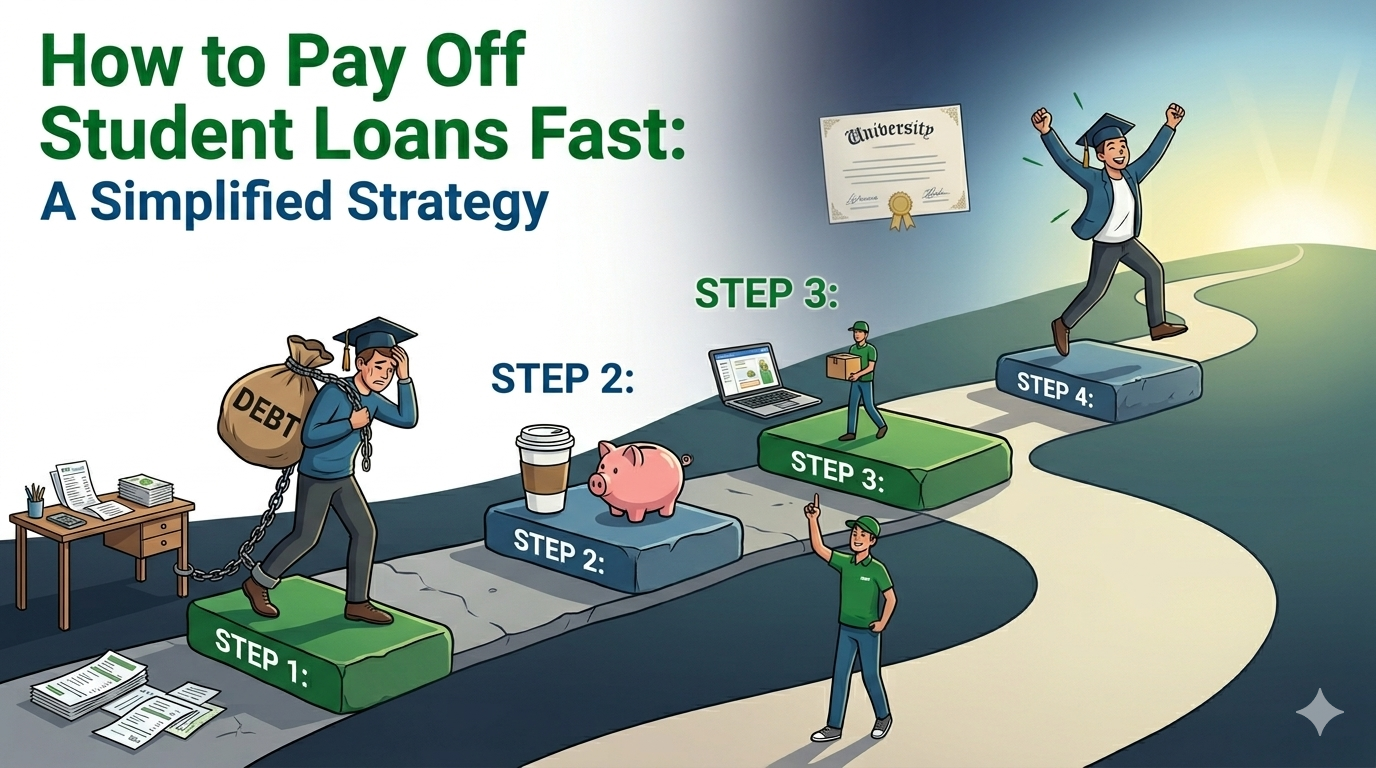
How to Pay Off Student Loans Fast
Student loan debt is one of the most common financial burdens for graduates worldwide. In India alone, education loan disbursements have grown dramatically over the past decade, with millions of students taking on debt to fund undergraduate and postgraduate degrees. The question most graduates face is not whether to repay — but how to do it as fast and cheaply as possible.
This guide gives you a concrete, prioritised repayment strategy — not generic advice. Whether your loan is with SBI, HDFC Credila, Axis Bank, or any other lender, these principles apply.
| Key Takeaway Paying off student loans faster is not just about willpower — it is about structuring your repayment to minimise total interest paid. Every extra rupee toward principal today saves you more than a rupee in the future. |
Step 1: Know Your Loan Inside Out
Before building any strategy, you must have complete clarity on what you owe. Many graduates make extra payments without understanding how interest accrues — and end up paying more than necessary.
Information You Must Gather Today
| Loan Detail | Where to Find It | Why It Matters |
| Outstanding principal | Loan statement / lender app | The actual amount on which interest accrues |
| Interest rate (fixed or floating) | Loan agreement | Floating rates may have increased since disbursement |
| EMI breakdown (principal vs interest) | Amortisation schedule | Shows how much of each payment reduces principal |
| Prepayment penalty (if any) | Loan agreement / lender | Some lenders charge 1–2% on early repayment |
| Moratorium period status | Lender | Interest during moratorium capitalises — check carefully |
Step 2: Attack the Loan with Two Proven Methods
Strategy A: Pay More Than the Minimum EMI
The single highest-impact action any borrower can take is paying more than the minimum EMI. Even a 10–20% increase in your monthly payment dramatically shortens the loan tenure and slashes total interest.
| Real Example A Rs. 15 lakh education loan at 11% for 10 years has an EMI of approximately Rs. 20,650. Paying Rs. 25,000 per month instead clears the loan in roughly 7 years — saving over Rs. 3.5 lakh in interest. |
Strategy B: Make Lump-Sum Prepayments
Whenever you receive a bonus, tax refund, or salary increment, direct a significant portion toward loan prepayment. Lump-sum prepayments directly reduce your outstanding principal, which immediately reduces the interest charged in subsequent months.
- Step 1: Confirm your lender’s prepayment process (online transfer, branch visit, or app)
- Step 2: Request that the extra payment be applied to principal, not the next EMI
- Step 3: Ask for an updated amortisation schedule after each prepayment
Step 3: Cut Interest Cost with Loan Refinancing
If your education loan carries an interest rate above 11–12%, explore refinancing through banks or NBFCs offering lower rates. Refinancing means taking a new, cheaper loan to pay off the existing expensive one — reducing your effective interest rate immediately.
When Refinancing Makes Sense
- Your credit score has improved since you took the original loan (720+ is ideal)
- Market interest rates have dropped since your loan was disbursed
- You have a stable income for at least 6 months — lenders need proof of repayment capacity
- The savings in interest outweigh any processing fees on the new loan
| Caution Government bank loans (SBI Scholar Loan, Bank of Baroda Baroda Gyan) often have lower rates than private NBFCs. Always compare the effective annual rate (EAR), not just the advertised rate, before refinancing. |
Step 4: Use Tax Benefits Intelligently
Section 80E of the Income Tax Act allows you to deduct the full interest paid on an education loan from your taxable income — with no upper cap. This deduction is available for up to 8 consecutive years from the year you begin repaying.
| Taxable Income Slab | Tax Rate | Tax Saved per Rs. 1 Lakh Interest |
| Up to Rs. 3 lakh | 0% | Rs. 0 |
| Rs. 3–7 lakh | 5% | Rs. 5,000 |
| Rs. 7–10 lakh | 10% | Rs. 10,000 |
| Rs. 10–12 lakh | 15% | Rs. 15,000 |
| Rs. 12–15 lakh | 20% | Rs. 20,000 |
| Above Rs. 15 lakh | 30% | Rs. 30,000 |
The tax saving does not reduce your loan — but it reduces your net cost of borrowing. Redirect your tax refund directly to loan prepayment for a compounding benefit.
Step 5: Increase Your Income to Accelerate Repayment
Frugality alone has limits. The most powerful way to pay off loans faster is to earn more. Even a Rs. 5,000–10,000 monthly side income directed entirely toward the loan can cut years off your repayment timeline.
High-Impact Income Boosters for Graduates
- Freelancing in your field — writing, coding, design, tutoring — platforms like Upwork, Fiverr, or Toppr
- Weekend or evening tutoring — especially for competitive exams in your subject area
- Monetise a skill on YouTube or a niche blog — takes 6–12 months but scales
- Negotiate a salary increment — a 15% raise matters more for loan repayment than most side hustles
- Sell unused assets — textbooks, electronics, or furniture from your student years
Your 90-Day Student Loan Action Plan
| Week | Action | Goal |
| Week 1 | Collect all loan documents, check current balance and rate | Complete financial clarity |
| Week 2 | Calculate EMI + 20% overpayment and set up standing instruction | Begin accelerated repayment |
| Week 3 | File 80E deduction claim (or set a reminder for tax season) | Reduce net borrowing cost |
| Week 4 | Research refinancing options if rate is above 12% | Potentially reduce interest rate |
| Month 2 | Identify one income-boosting activity and start it | Create extra repayment fuel |
| Month 3 | Make first lump-sum prepayment from any extra income | Reduce principal directly |
Frequently Asked Questions
Does paying extra EMI reduce the loan tenure or the EMI amount?
This depends on your lender. Most banks in India apply extra payments to reduce tenure by default, which is the better outcome — you pay less total interest. Always confirm with your lender and request a tenure-reduction rather than EMI-reduction when making prepayments.
Is there a penalty for prepaying an education loan in India?
Most government and public sector bank education loans have no prepayment penalty. Some private lenders charge 1–2% on the prepaid amount. Always check your loan agreement before making a large lump-sum payment.
Should I invest or pay off my student loan first?
If your loan interest rate is above 10–11%, prioritise repayment — guaranteed returns from debt elimination often beat market returns on equivalent investment risk. If your rate is below 8–9%, investing in equity index funds via SIPs while making minimum loan payments may yield better long-term outcomes.
Can I get a moratorium extension if I cannot find a job?
Yes — most lenders offer a 6–12 month moratorium extension on production of proof of unemployment or continued education. Contact your lender proactively rather than missing payments, as missed EMIs damage your credit score and trigger penal interest.
Conclusion
Paying off student loans fast requires clarity on your loan terms, a strategy that directs extra income toward principal reduction, intelligent use of tax deductions, and consistency over time. The graduates who clear debt fastest are not necessarily the highest earners — they are the most intentional about every rupee they direct toward repayment.
Link this article to your budget and revisit your repayment plan every six months. Every increment in income is an opportunity to move the payoff date forward.

