


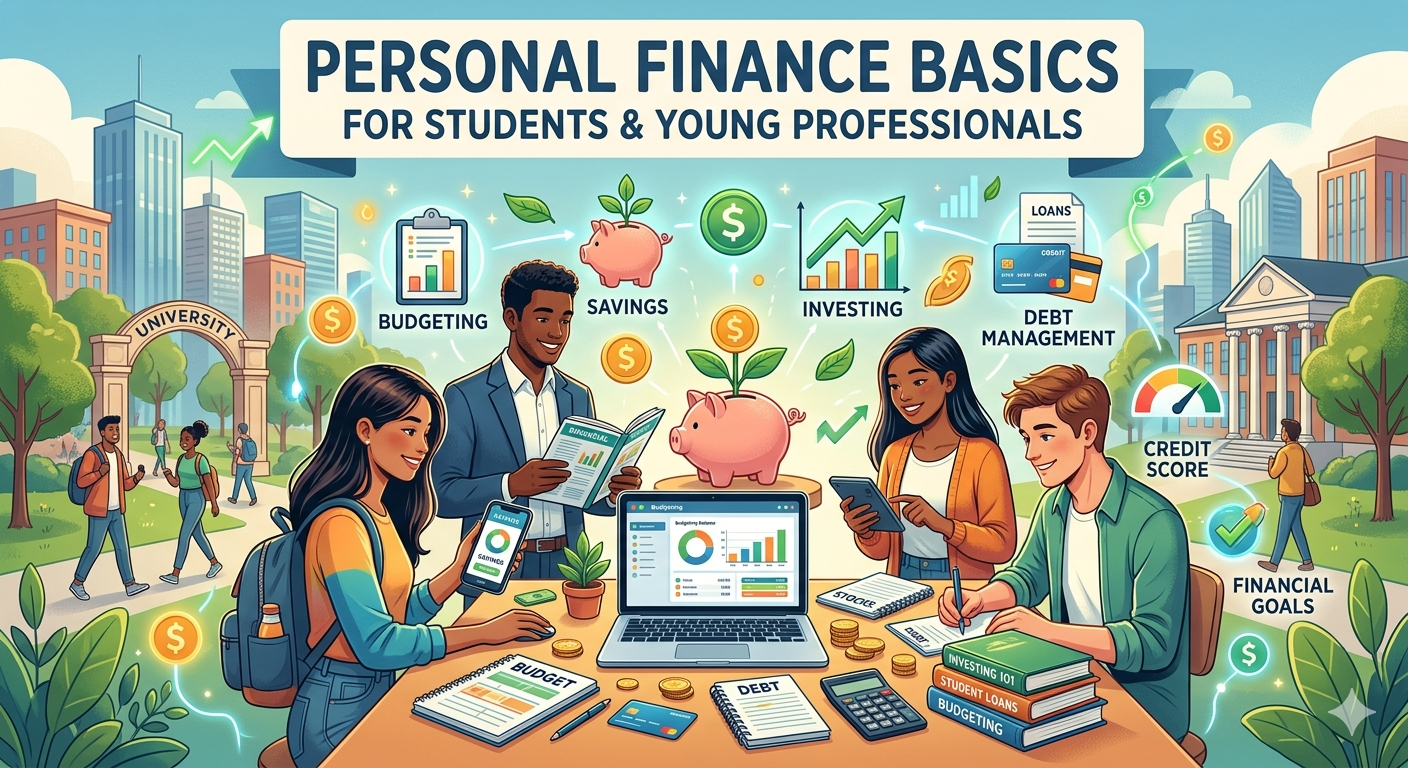
Personal Finance Basics: A Complete Guide
Understanding personal finance basics is one of the most valuable skills you can develop – yet most people never receive a formal education in it. Whether you are earning your first paycheck or optimizing your mid-career wealth strategy, mastering the fundamentals of budgeting, saving, investing, and debt management will shape your financial future more than any single raise or windfall ever could.
This guide is written for people who already understand the basics of earning and spending but want a structured framework to move from financial awareness to financial security. We cover the seven pillars of personal finance, actionable strategies for each, and common mistakes to avoid.
| Key Takeaway Personal finance is not about deprivation – it is about intentionality. Every dollar you allocate deliberately works toward your goals. The earlier you build these habits, the more powerful compound growth becomes. |
1. Know Your Starting Point: Net Worth
Before you can improve your finances, you need an honest baseline. Your net worth – total assets minus total liabilities – is the single most important number in personal finance.
How to Calculate Your Net Worth
| Category | Examples | Typical Value Type |
| Assets | Checking, savings, investments, property, retirement accounts | What you own |
| Liabilities | Mortgage, student loans, credit card balances, car loans | What you owe |
| Net Worth | Assets minus liabilities | Your financial position |
Tracking net worth monthly – even when the number is negative – reveals trends that monthly budgets alone cannot show. Many high earners have low net worth because of lifestyle inflation; many modest earners build substantial wealth through consistent saving and investing.
Practical Tools
- Spreadsheet (Google Sheets or Excel): free, fully customizable
- Personal Capital / Empower: syncs accounts automatically, shows investment performance
- YNAB (You Need A Budget): stronger on cash flow, weaker on net worth tracking
2. Budgeting: The Foundation of Personal Finance
A budget is not a restriction – it is a spending plan. The goal is to ensure every rupee (or dollar) has a job before the month begins, rather than wondering where it went after the month ends.
The 50/30/20 Rule – and When to Adjust It
The 50/30/20 framework is a widely used starting point:
- 50% Needs – housing, utilities, groceries, insurance, minimum debt payments
- 30% Wants – dining out, subscriptions, travel, entertainment
- 20% Savings & Debt – emergency fund, investments, extra debt payments
For those in high cost-of-living cities or aggressively paying off debt, a 60/20/20 or even 70/10/20 split may be more realistic. The exact percentages matter less than having a plan and reviewing it monthly.
Zero-Based Budgeting: A More Precise Approach
Zero-based budgeting assigns every single rupee of income to a category – needs, wants, savings, or debt – until the month’s budget reaches zero. Income minus all allocations = zero. This approach eliminates the vague ‘leftover money’ that tends to evaporate.
Steps to Build a Zero-Based Budget
- List all income sources for the month (salary, freelance, rental income)
- List fixed expenses (rent, EMIs, subscriptions with fixed amounts)
- Estimate variable expenses (groceries, fuel, entertainment)
- Allocate remaining income to savings and investment goals
- Adjust until income minus all categories equals zero
| Pro Tip Review your budget mid-month, not just at month-end. Catching overspending in week two gives you time to adjust, while catching it in week four only produces regret. |
3. Emergency Fund: Your Financial Shock Absorber
An emergency fund is liquid cash set aside exclusively for unexpected, non-negotiable expenses – a medical bill, a car repair, or sudden job loss. It is not a vacation fund or a down payment fund. Its only job is to prevent one bad event from becoming a financial crisis.
How Much Should You Save?
| Situation | Recommended Emergency Fund | Rationale |
| Stable job, dual income household | 3 months of expenses | Lower income-loss risk |
| Single income, variable pay, or freelance | 6 months of expenses | Higher volatility exposure |
| Business owner, specialized career | 9–12 months of expenses | Longer recovery time if income stops |
Where to Keep Your Emergency Fund
- High-yield savings account – earns interest, remains accessible within 1–3 business days
- Liquid mutual funds (India) – marginally higher returns, same-day to next-day redemption
- NOT in stocks or equity funds – market downturns often coincide with personal crises
4. Debt Management: Eliminating High-Interest Liability
Not all debt is created equal. A low-interest home loan building equity is fundamentally different from a credit card balance accruing 36% annual interest. Personal finance basics require distinguishing between debt that works for you and debt that drains you.
Two Proven Debt Payoff Strategies
The Avalanche Method (Mathematically Optimal)
List all debts from highest interest rate to lowest. Pay the minimum on all debts while directing any extra money to the highest-rate debt. Once it is paid off, roll that payment to the next highest rate. This method minimizes total interest paid.
The Snowball Method (Psychologically Effective)
List all debts from smallest balance to largest. Pay the minimum on all while putting extra toward the smallest balance. Quick wins build momentum and motivation. Studies suggest this method leads to higher completion rates for people who have struggled with debt payoff in the past.
| Which Method is Right for You? Choose Avalanche if you are disciplined and motivated by numbers. Choose Snowball if you have several small debts and need early wins to stay committed. Hybrid approaches – clearing one or two small debts first, then switching to Avalanche – also work well. |
Good Debt vs. Bad Debt at a Glance
| Debt Type | Interest Rate Range | Strategic Verdict |
| Home loan / Mortgage | 7–9% | Generally acceptable – builds equity |
| Education loan | 8–12% | Acceptable if ROI on degree is positive |
| Car loan | 9–14% | Minimize – depreciating asset |
| Personal loan | 12–24% | Pay off aggressively |
| Credit card | 24–42% | Eliminate immediately – highest priority |
5. Saving vs. Investing: Understanding the Difference
Saving and investing are often used interchangeably, but they serve different purposes in a sound personal finance strategy. Saving preserves capital with low risk and high liquidity. Investing grows capital over time by accepting short-term volatility in exchange for long-term returns.
The Power of Compound Interest
Albert Einstein reportedly called compound interest the eighth wonder of the world. Whether or not the quote is authentic, the math is undeniable. Compound interest means your returns generate their own returns – accelerating growth over time.
| Compound Interest Example Investing Rs. 10,000 per month starting at age 25, earning 12% annual returns, grows to approximately Rs. 3.5 crore by age 55. Starting the same investment at age 35 yields only Rs. 1 crore – one-third as much – despite contributing for just 10 fewer years. Time is the most powerful variable in compounding. |
Core Investment Vehicles (India Context)
| Instrument | Risk Level | Best For |
| PPF (Public Provident Fund) | Low | Tax-free, guaranteed returns – 15-year lock-in |
| ELSS Mutual Funds | Medium-High | Tax-saving + equity growth – 3-year lock-in |
| Index Funds (Nifty 50 / Sensex) | Medium | Long-term wealth – passive, low-cost |
| Direct Equity | High | Research-driven, high-conviction stock picks |
| Fixed Deposits | Very Low | Capital preservation, short-term goals |
| NPS (National Pension System) | Low-Medium | Retirement – tax benefits, very long lock-in |
The Investment Priority Ladder
- Build emergency fund first (3–6 months of expenses)
- Capture any employer match on EPF or NPS (free money – never skip this)
- Pay off high-interest debt (credit cards, personal loans above 15%)
- Max out tax-advantaged accounts (PPF, ELSS up to Section 80C limit)
- Invest in low-cost index funds via SIPs for long-term goals
- Explore direct equity or real estate only after steps 1–5 are solid
6. Insurance: Protecting What You Have Built
Wealth creation and wealth protection are two sides of the same coin. Inadequate insurance can undo years of financial progress in a single medical event or accident. Insurance is not an expense – it is the cost of not gambling with your financial security.
Essential Insurance Coverage
- Term Life Insurance: 10–15x your annual income, especially if you have dependants. Buy pure term – avoid ULIPs and endowment plans that bundle insurance with poor investment returns.
- Health Insurance: Minimum Rs. 10–20 lakh family floater plan, or higher if you live in a metro. Do not rely solely on employer health cover – it lapses when you change jobs.
- Personal Accident and Disability Cover: Often overlooked, this covers income loss from injury – a risk higher than death for most working-age adults.
7. Financial Goals: Connecting Money to Purpose
Without clear goals, personal finance becomes an abstract exercise in restraint. Goals transform budgeting and investing from obligations into strategies. They answer the question: what is all this saving actually for?
Short, Medium, and Long-Term Goal Framework
| Time Horizon | Example Goals | Recommended Vehicles |
| Short-term (0–2 years) | Emergency fund, vacation, gadget purchase | High-yield savings, liquid funds |
| Medium-term (2–7 years) | Down payment, car, higher education | Debt mutual funds, RD, balanced funds |
| Long-term (7+ years) | Retirement, children’s education, financial independence | Equity index funds, PPF, NPS, ELSS |
The SMART Goal Method Applied to Finance
- Specific: ‘Save Rs. 5 lakh for a house down payment’ not ‘save more money’
- Measurable: Track monthly contributions against the target
- Achievable: Ensure the required monthly saving fits your budget
- Relevant: Goal aligns with your life priorities, not social pressure
- Time-bound: Set a clear deadline – ‘by December 2028’
8. Common Personal Finance Mistakes (and How to Avoid Them)
Lifestyle Inflation
Every time your income rises, expenses tend to rise proportionally – this is lifestyle inflation. The antidote is to direct at least 50% of every income increase to savings or investments before adjusting your spending.
Ignoring Inflation in Financial Planning
Rs. 1 crore today will not have the purchasing power of Rs. 1 crore in 2045. When projecting retirement needs or long-term goals, always apply an inflation adjustment – typically 6–7% annually in India.
Waiting for the ‘Right Time’ to Invest
Market timing consistently underperforms time in the market. Systematic Investment Plans (SIPs) remove the timing question entirely by investing a fixed amount monthly regardless of market levels, averaging your cost over market cycles.
Neglecting the Will and Nomination Documents
Estate planning is not only for the wealthy. Ensure all financial accounts – bank, mutual funds, life insurance, EPF – have updated nominees. A simple will prevents legal complications for your family.
Frequently Asked Questions: Personal Finance Basics
What is the most important rule in personal finance?
The most important rule in personal finance is to spend less than you earn and invest the difference consistently over time. No investment strategy, tax optimization, or budgeting app matters if you consistently spend more than you bring in.
How much of my salary should I save each month?
A widely recommended starting point is saving at least 20% of your take-home salary. This includes contributions to an emergency fund, retirement accounts, and other investment goals. If 20% is not immediately achievable, start with 10% and increase by 1–2% every six months.
What is the difference between saving and investing?
Saving involves setting money aside in low-risk, liquid accounts (savings account, fixed deposit) to preserve capital and fund near-term goals. Investing involves placing money in assets like stocks, mutual funds, or real estate with the expectation of long-term growth, accepting some short-term volatility in exchange for higher returns.
How do I start investing with a small amount of money?
Start with Systematic Investment Plans (SIPs) in index mutual funds – many platforms allow you to begin with as little as Rs. 500 per month. Consistency matters far more than the initial amount. Increase contributions as your income grows.
What is an emergency fund and how do I build one?
An emergency fund is 3 to 6 months of essential living expenses held in a liquid, low-risk account. To build one, automate a fixed monthly transfer to a dedicated high-yield savings account immediately after each paycheck. Treat it as a non-negotiable bill, not an optional saving.
Is debt always bad for personal finance?
No – not all debt is harmful. Low-interest debt used to acquire appreciating assets (a home loan, a student loan for a high-ROI degree) can be strategically sound. High-interest consumer debt – especially credit cards – is almost always detrimental and should be paid off as quickly as possible.
Conclusion: Start Small, Stay Consistent
Mastering personal finance basics does not require a finance degree or a high income – it requires a system and the discipline to follow it. The seven pillars covered in this guide – net worth tracking, budgeting, emergency savings, debt management, investing, insurance, and goal-setting – work together as an interconnected framework.
The most common mistake is waiting until finances are ‘better organized’ to start. The second-best time to start is today. Pick one area from this guide – build your emergency fund, create your first budget, or open a SIP for Rs. 1,000 per month – and begin. The rest follows.
| Action Steps This Week 1. Calculate your current net worth using a spreadsheet. |

